

Table of Contents
Introduction
Understanding the Quaker Parrot
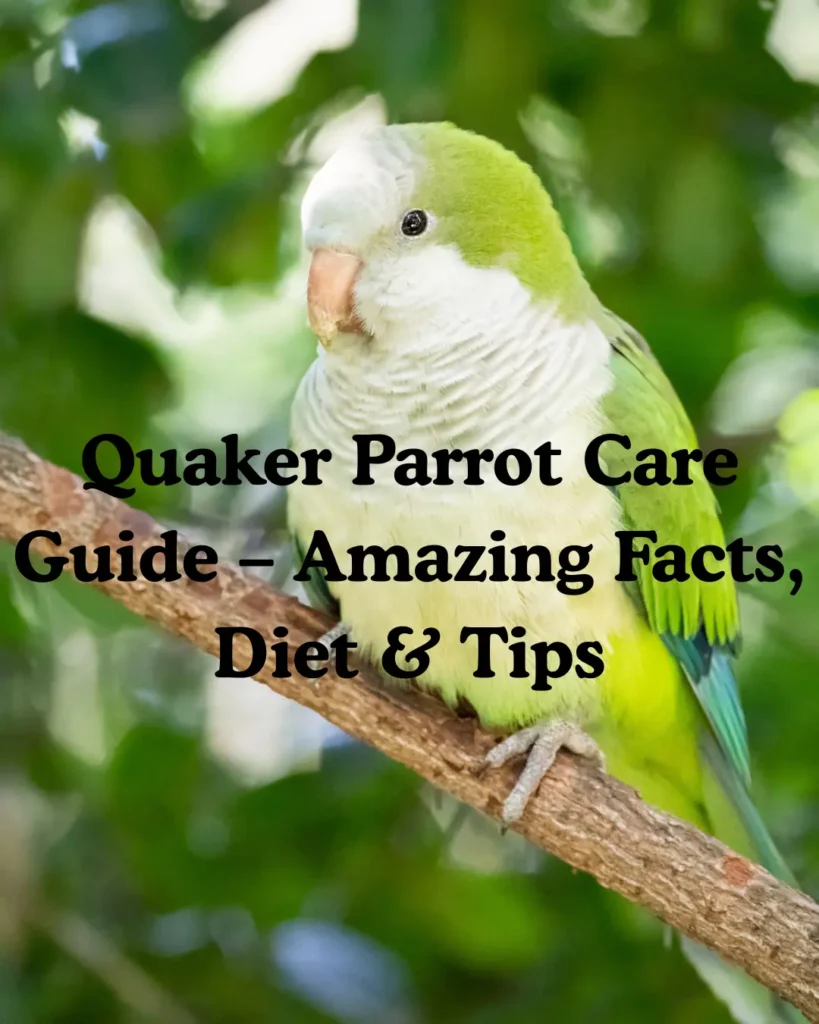
Quaker parrots are also called the Monk Parakeets. These parrots are one of the most famous and charming in the world. Their beauty, their ability to speak, and their love for their owner distinguish them from other birds. They are small but also very attentive. Their babies are full of strong emotions and intelligence, which require hard work and attention, which makes them popular among people.
If you are not in this field or are trying to find out whether Quaker parrots are the right pets for you to keep, we will provide you with all the details about them in this blog. We will do our best to provide you with all the necessary information (dietary diseases, breeding, etc.) in a clear and easy-to-understand manner.
What Is a Quaker Parrot?
The Quaker Parrot is a bird from South America that is found in small to medium sizes. These parrots love to talk. They are very happy to mingle with people, imitate their voices, and even participate in daily affairs. Although they have many characteristics, their nest-making behavior makes them even more important. Other parrots look for hollow places to lay their eggs, while these birds, unlike them, build large and spacious nests.
Due to their intelligence, they learn words very quickly. It has even been seen that they learn entire sentences. If we talk about their lifespan, they can live for 20 to 30 years.
Natural Habitat
Quaker Parrots thrive in open forests, grasslands, and light forest areas. This is why they can withstand the rigors of different weather conditions when kept as pets, which makes them a hardy bird. They build large nests made of branches and sticks. Apart from this, different pairs live in the same nest, but each pair has its own room. This is why when they are kept as pets in the house, they start considering that family as their own.
Unique Personality Traits
Quaker parrots are easier to handle than other large parrots, such as African Greys, cockatoos or Amazons. When it comes to their charming qualities, their boldness is at the top. They are not shy about talking at all. If they are hungry, they will tell you to feed them, or if they want to play and need attention, they will still try to get you to come to them. This is why they are called natural performers who make themselves the center of attention, especially to the people they trust.
When it comes to their loyalty, they maintain a strong bond with the owner they fall in love with. It has been seen that they give their master status to only one or two people in a house. If they have given you the master status once, then after that, they will sit on your shoulder, enter your room, and happily chirp and express their love. In addition, they will also like to play with your hair. It will listen to you carefully and will love you too.
Along with making these sounds, it also speaks complete sentences in human language, which makes people understand that there is a human being there. Apart from this, it also knows when to say what sentence. For example, if someone enters the room, it will make a ‘hello’ sound upon seeing them, which can be a good indication of its intelligence.
Physical Characteristics
Appearance and Color Variations
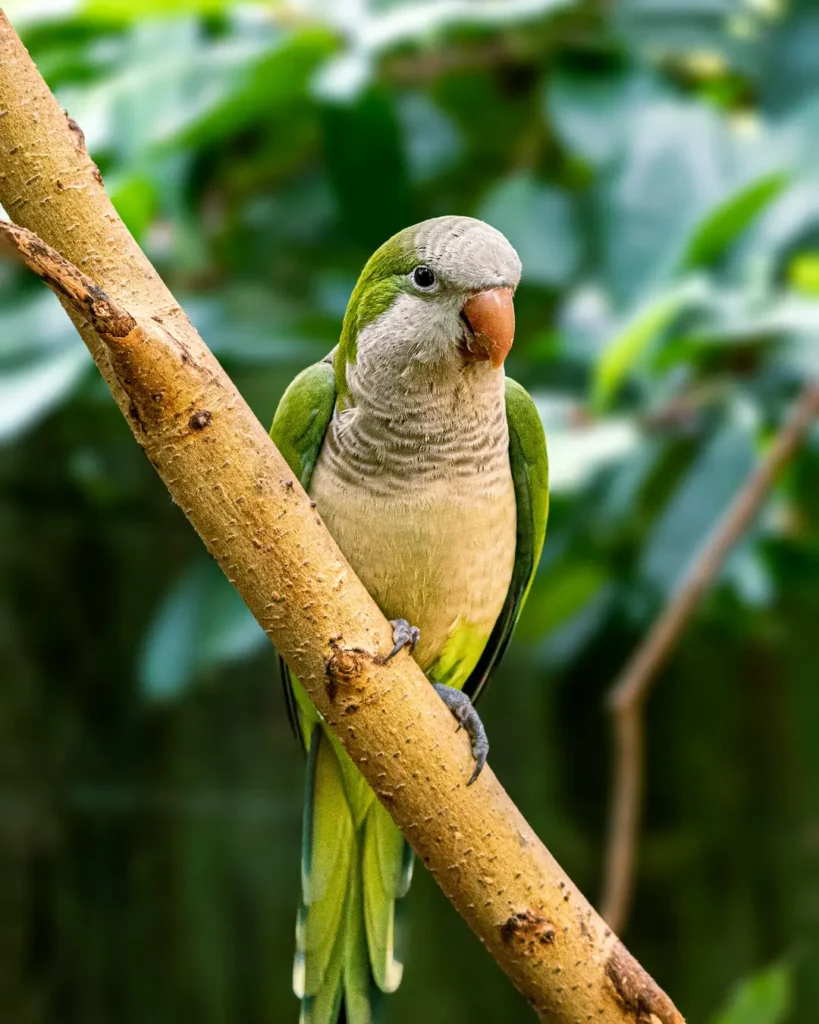
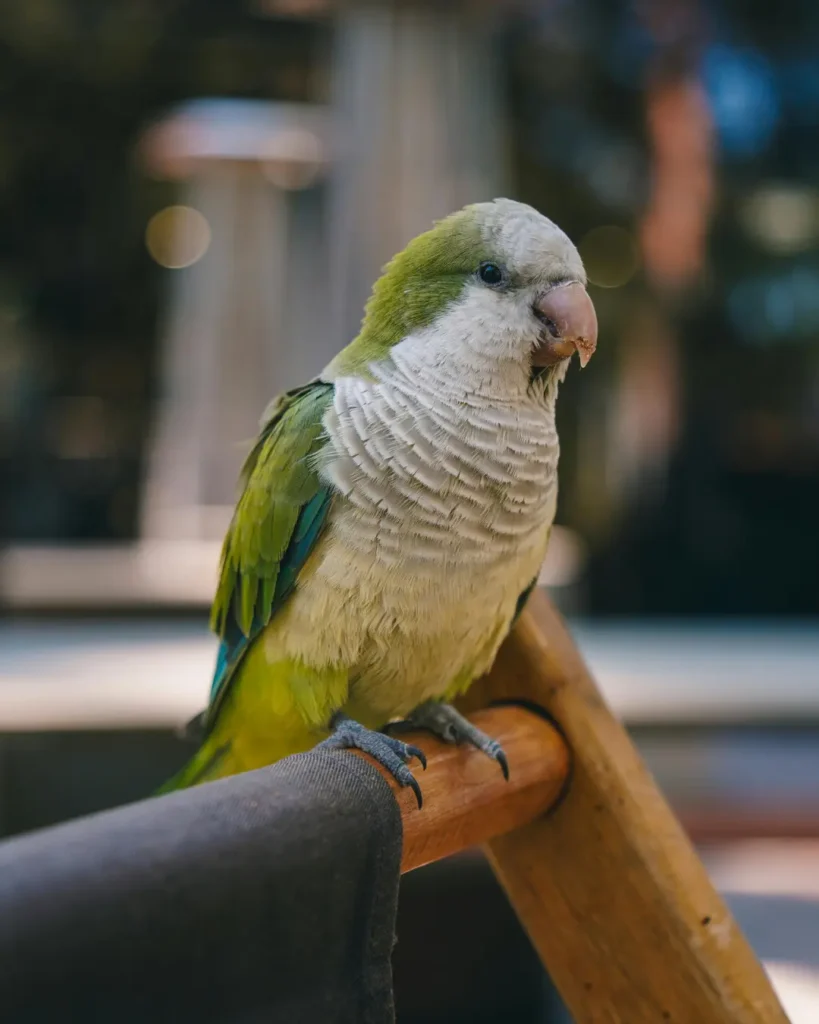
Quaker parrots are found in many mutations, but their common breed is naturally green with a gray face and breast. They are called Quaker because of the resemblance of their face to a Quaker. They also express their emotions with their dark brown or black eyes. They also express their emotions through their facial expressions and posture. They also fluff their wings or wag their tail when they seek attention.
How Big Do Quaker Parrots Get?
Quaker parrots fall into the small-to-medium parrot category, but their presence often feels much larger than their physical size. An adult Quaker parrot grows to about 10 to 12 inches and weighs about 150 g.
Differences Between Wild and Domesticated Quakers
Wild Quaker parrots and domesticated Quakers are actually the same, but their way of living is completely different from each other due to the change in environment. Wild Quaker parrots live in the form of flocks. Sometimes it has been seen that they consist of thousands of families. Different classifications have also been seen within them, and responsibilities are also assigned to each Quaker parrot according to the classification, such as some Quaker parrots have to handle the feeding issues, some have to do the nesting responsibilities, etc.
If we talk about caged Quakers, then these Quaker parrots are raised in a controlled environment where food, security, and shelter are all provided by their owner. Unlike wild Quakers, they live alone or in pairs at most. In addition, wild Quakers eat a variety of foods found in the wild, while domesticated ones will often eat what their owners offer them.
Quaker Parrot Behavior
Intelligence and Talking Ability
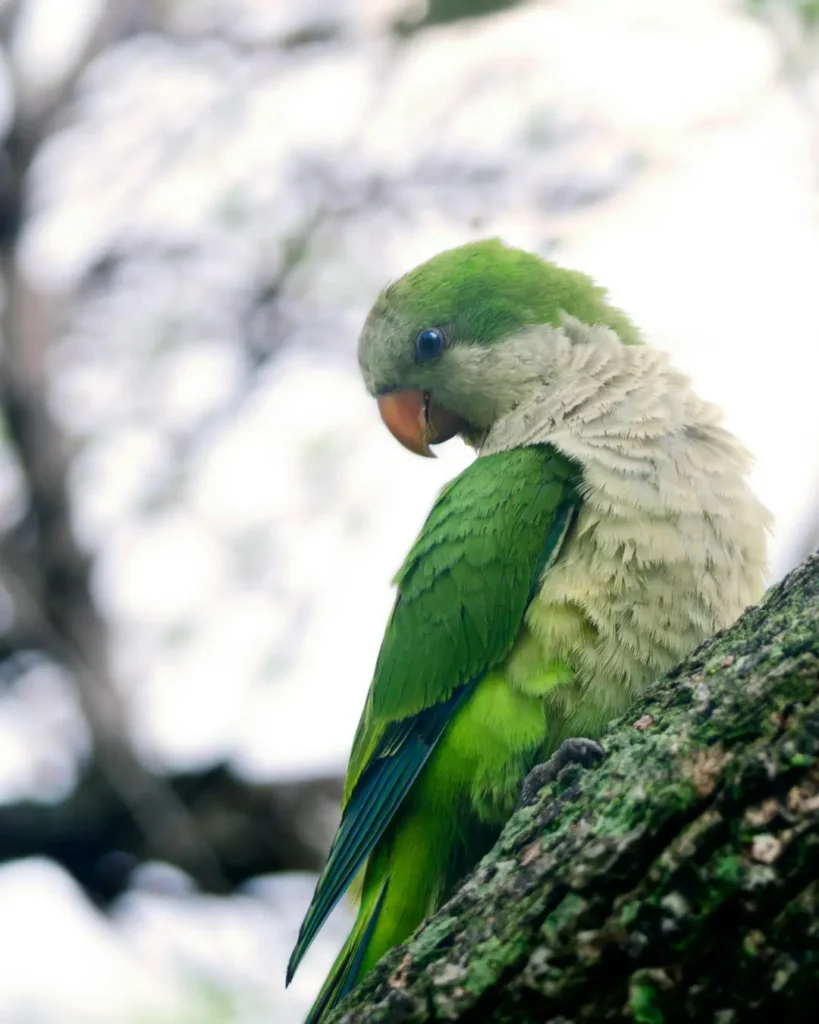
Quaker parrots are small yet exceptionally intelligent. These birds excel at solving intricate problems and mastering new skills. Their intelligence is evident: when their owner approaches, they respond instantly to the sound of footsteps.
It has even been observed that they learn not only small sentences but also big sentences. Not only that, but they also learn when to say these sentences. For example, if they need attention, they can attract their owner or another person by saying the phrase “come here, please.” This is what distinguishes them from other large parrots.
Their learning process is not limited to sentences, but they can also repeat other sounds, such as the doorbell ringing, the ringtone of the mobile phone, etc.
Quaker parrots keenly observe those around them, discerning what triggers anger or happiness, and imitate these behaviors. They also excel at solving puzzles. With training, they can easily unlock simple locks by watching how their owner opens the cage door.
Social Behavior
These parrots live in the forests in the form of a flock and are always busy in talking or working. In addition, their flock likes to stay in the same nest and is busy fulfilling its own responsibilities. That is why when someone wants to keep it in their home, it immediately gets along with them because it also wants to consider it a part of its flock. It is interested in doing some work in the house with their owner. That is why it has been seen that if the owner is doing some work, it always tries to help him in some way or another.
Common Behavioral Problems & Solutions
Like other birds, Quaker parrots also face some problems. Some of these problems are as follows:
- The first and most important problem is territoriality. Especially when someone comes near their cage, they are ready to defend it because they consider their cage as their nest. But when these birds are in the wild, they fiercely protect their nests together. To solve this problem, one should approach the cage slowly.
- The second problem with them is when they feel discouraged or ignored. They scream loudly to attract the attention of their owner. If you respond to their screams, they will continue to scream in the same way to attract your attention. But if you remain silent and leave them alone, they will understand that their screaming is useless. In addition, if you encourage them by giving them a name or praising them at times when their behavior is normal, they will prefer to be normal instead of screaming.
- Another problem that has been observed in them is their biting behavior. When someone comes close to them, they bite them in self-defense or out of fear. To solve this problem, first of all, do not go near them at once, but first teach them the habit of sitting on a stick or offer them some food that will deepen their relationship with you, and whenever you come near them, they should not bite you.
Housing Requirements
Choosing the Right Cage
The choice of cage is the most important thing for keeping cockatiels. Their cage should be strong and large. It should be at least 24 x 30 x 24 inches, but this is the minimum. The larger it is, the better. Along with increasing its size, its cage should also be strong. The lock you put on its cage should be durable and cannot be easily opened because these birds open ordinary locks easily. Try to keep the main door of their cage large so that these birds can go in and out.
Essential Cage Accessories
It is very important to have food bowls, water bowls, a box for them to live in, and a hammock or something like a rope inside the parrot’s cage. These are the basic things that every parrot needs. Apart from this, you can also give your parrot some toys to chew on, which will keep it busy throughout the day. You should try not to keep any sharp objects in their cage that can hurt them.
Safe Environmental Setup
The most important thing behind making a cage is a safe environment. Just like you make your home in an area where the environment is safe in every aspect. Similarly, these parrots also need an environment where they are safe from other animals. The most important thing behind protecting their lives is where their cage should be kept in the house. For this, a place should be chosen where these parrots are under the supervision of their owner.
Diet and Nutrition
What Quaker Parrots Should Eat
Quaker parrots are energetic and disease-free when they eat a healthy diet. A healthy diet includes 60-70% high-quality pellets, 20-25% fresh vegetables, and 5-10% fruit.
Foods to Avoid
As important as it is to know what to include in your diet, it is equally important to know what to avoid altogether. Foods to avoid are avocado foods, caffeine-added products, sugar-added products, and raw beans.
Training a Quaker Parrot
Basic Commands
A parrot training session is very interesting because it not only trains the parrot but also builds a deep bond between you and your parrot.
The first step in training a Quaker parrot is to place the parrot on your hand. Whenever you say a specific command, your parrot should immediately sit on your arm or on your shoulders. The second step is if your parrot is sitting on your shoulder or hand, and you want to get it down, teach it a command that, when you say it, it should get down from your shoulder.These two commands should be spoken when the parrot is close to you.
Apart from that, if you want to call the parrot towards you, teach it a command like “Come here.” If you say “Come here,” your parrot should fly towards you and reach you as soon as possible. The “Come here” command is a little more difficult than the other two commands because it creates a distance between you and your parrot. For this, try to start saying this command to the parrot from close by. When it comes close to you, encourage it by giving it some food. These are the basic commands. Which should be mandatory for your parrot.
You should hold training sessions for your parrot twice a day, and each session should last for five to ten minutes. If you and your parrot develop a good relationship, it is possible that your parrot will learn the commands quickly.
How to Stop Biting
The next challenge for the owner of the parrot is to stop the biting habit of these parrots. They bite for different reasons.
We will explain all these reasons in turn and also suggest solutions to them. The first and main reason is fear. Your parrot tries to bite you out of fear. The solution to this is that whenever you bring it new, you must give it some time in which it can interact with you. If a lot of time has passed since this happened, but it is still biting, then to end this habit, you should go near it quietly and offer it some food. In this way, the fear of you in its heart will start to disappear in a few days.
Another reason may be that your parrot considers its cage as its home and does not want anyone to come near it. That is why whenever you go near it, it will try to bite you. The best solution to this is that if you have to go near its cage, first move it to another cage. After that, make the settings you have to make with its cage easy. In this way, it will neither bite you nor will it be against you.
There is a third reason that is mostly seen during the breeding season. During the breeding season, these parrots have been seen biting due to a change in their hormones. Therefore, at such times, try to avoid going near them.
How to Improve Talking Skills
Quaker parrots naturally love to talk, and they try to learn as many new words and sounds as possible. Usually, people talk to them simply, which is effective for their learning process, but there are some methods that you can adopt to improve their learning process.
The first method that I am going to teach you is that whenever you are free, come close to your parrot and talk to him about anything you want, and also give him a treat.
Apart from that, if you want your parrot to talk with context, then in the morning when you are going to work, you should say “goodbye” to him, and when you are coming back from the office, you should say “hello” to him. Similarly, when you are sleeping, say “good night” to him, and when you wake up in the morning, say “good morning” to him, and when you are pouring water into their bowl, use the word “water,” and when you are giving them a feed, use the word “feed.” By using all these methods, your parrot will learn more efficiently with context.
Health & Wellness
Common Health Issues
Quaker parrots are generally hardy but can suffer from some health problems if they are not provided with the proper diet and environment. The most common health problem faced by these parrots is fatty liver disease. This is usually caused by eating large amounts of nuts and sweet fruits.
Another problem that causes them problems is infection. These parrots are prone to respiratory infections through the air.
Apart from this, one problem that is commonly seen is the plucking of the feathers of these parrots. This problem can also be due to boredom and can also be due to allergies.
How to Prevent Diseases
Quaker parrots usually do not show their illness because when these parrots live in the wild, they know that if their illness is revealed to other birds of prey, they will hunt them. Therefore, these parrots do not show it even when they are raised in the home.
The most basic task of disease prevention is to standardize the diet and ensure that they are fed a small amount of vegetables every day. Avoid foods that contain a lot of sugar, as too much sugar can lead to obesity and liver problems. In addition, if there is dirt in your parrot’s cage, the chances of contracting this disease increase even more. Therefore, cleanliness should be adopted because cleanliness can prevent disease. In addition, do not spray any type of product near your parrot’s cage because the spray contains chemical poisons that harm the health of these parrots.
Signs Your Quaker Needs a Vet
Quaker parrots hide their illness, but when it becomes unbearable, they start showing it. Whenever their illness starts to appear, understand that they need immediate treatment. Usually, first of all, they change their diet. They eat less than usual, or do not eat their favorite things at all, or eat less. Likewise, they drink more water than necessary, and they also start losing weight. In addition, if you see them breathing with their mouths open, making snoring sounds, or water flowing from their nose, take them to the veterinary center immediately and start treating them.
Breeding Quaker Parrots
Breeding Behavior
During the breeding season, Quaker parrots become more territorial and attentive to their nest than usual. During the breeding season, they are noisier than usual and spend more time in pairs. Their entire attention is on their nest, and whenever you see them, they are engaged in some task such as shredding paper, collecting materials, or bringing anything close to their nest.
In addition, during the breeding season, it has been seen that they also protect their partner in case of danger and become more aggressive.
Nest Building and Egg Laying
You will be surprised to know that, unlike other parrots, Quakers build their nests in trees with the help of sticks. Another important thing is that their nests are not just for a couple, but for the whole family, who have separate apartments. Usually, other species of parrots like to build nests inside trees and live in pairs. The interesting thing about these parrots is that they collect materials in their nests according to their own wishes.
In addition to sticks, strips of paper and pieces of cardboard are also found inside their nests. If you also want to keep them at home, the box must be greater than 12 * 12 * 12. In addition, their box should be made of solid wood with an internal hole, and that hole should also be of medium size. In addition, you should put cardboard and paper, etc., in their cage so that they can collect it and put it in the box.
During the breeding season, these parrots usually lay four to eight eggs, and the female incubates them for about 23 to 28 days, while the male parrot’s job is to protect their nest.
If you want to breed these parrots at home, then you should provide them with a suitable environment and a diet rich in vegetables, protein, and calcium to meet their dietary needs. In addition, keep their cage where they can feel safe from predators.
Caring for Baby Quakers
The real challenge of the Quaker parrots begins when their young hatch. In the early days, their young fully depend on them because neither their young have feathers on their bodies nor can they see.
In the early days, the female stays in the nest all the time and keeps her young warm, while their father, the male parrot, arranges food for them and protects their nest. When they are 10 to 14 days old, they open their eyes and become able to see. This is the time when their owner touches them with his hand to get them used to him, but try to make that touch soft, not hard.
In three to four weeks, feathers start growing on the body of these parrots, and they start maintaining their body temperature. This is the time when the owner of these chicks starts feeding them with their own hands.
When their babies are five to six weeks old, they start sitting on the nest box. This is the time when they start snatching food from each other. This is the time when the chick that is the most active grows faster than the others.
The final stage of these chicks is eight to 10 weeks old, their wings are fully developed, and they are able to fly. This is the time when they are able to eat solid food. This is the time when they start flying freely.
Cost of Owning a Quaker Parrot
Initial Costs
It is important to know the costs of keeping a Quaker parrot before owning one. The price of a Quaker parrot can range from $300 to $1,500 depends upon their color and mutation. The price of the cage can start from $150 to $600. Basic supplies can range from $50 to $150.
In addition, you should keep in mind the cost of $30 to $50 for their food and $80 to $200 for doctor’s fees or medicines. Overall, if the cost of keeping a Quaker Parrot is estimated, it can go up to a minimum of $600 and a maximum of $1500.
Is a Quaker Parrot Right for You?
Before you bring a Quaker parrot into your life, you should consider whether you will really be able to do anything for it, whether you will be able to provide it with the things it needs, and whether you will be able to give it the attention and time it needs. It is not just a bird, but it becomes a member of your family that will stay with you for a long time.
If you spend a lot of time away from home, we would not recommend keeping a parrot at all. If you are a quiet person, we would not recommend keeping one because they like to talk a lot. Quakers have a lifespan of 20 to 30 years, so they live a long time. You will have to take care of them for a long time.
Conclusion
Quaker parrots are small in size but unmatched in beauty and intelligence. By providing them with a balanced diet, attention, and basic needs, you can bring a new wave into your life. Every moment of their life, be it breeding season, egg-laying time, raising chicks, building or protecting their nest, will leave a memorable moment for you.
The lives of these parrots are full of challenges, but they overcome these challenges with their courage and dedication. Humans should also overcome the challenges they face in life with the same hard work and dedication.
FAQs
- Are Quaker parrots good for beginners?
Ans. Yes, if someone has fulfilled their needs and spends time with them every day.
- Do Quaker parrots talk better than other small parrots?
Ans. Yes, these are the best parrots among the little parents who can use words in context.
- How long does a Quaker parrot live?
Ans. Quaker parents can live for 20 to 30 years if they are given a good diet and environment.
- Do Quakers get along with other pets?
Ans. Yes, they can live with other animals and birds, but it is better to keep them in a separate cage.
- How much attention does a Quaker parrot need daily?
Ans. At least one to three hours of time should be given to them every day.
Please don’t forget to leave a review.
Explore more by joining me on www.animalfeather.com