
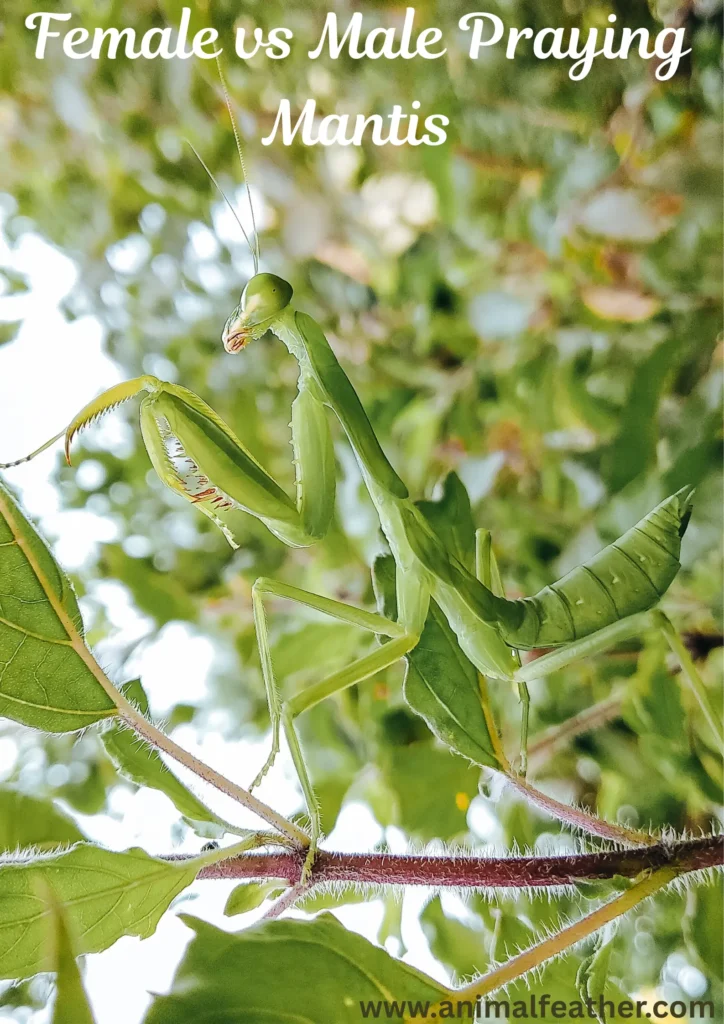

Female praying mantises are generally larger, heavier, and live longer than males. Male praying mantises are smaller, lighter, and much better fliers, allowing them to travel in search of mates. Although both sexes are skilled predators, they have evolved different characteristics to improve their chances of survival and reproduction.
Introduction
At first glance, a female and a male praying mantis may appear almost identical. They both have triangular heads, large compound eyes, folded front legs, and an incredible ability to blend into their surroundings. However, a closer look reveals several important differences that make each sex uniquely adapted to its role in nature.
Female praying mantises are powerful hunters with larger bodies that help them produce and carry eggs. Males, on the other hand, are slimmer and more agile. Their lightweight bodies and longer wings allow them to fly efficiently in search of females during the breeding season.
Whether you’re a nature enthusiast, gardener, photographer, or someone raising a pet mantis, learning how to tell the difference between a male and female praying mantis can help you better understand these remarkable insects.
In this guide, we’ll compare their size, appearance, behaviour, lifespan, hunting skills, and mating habits while sharing practical tips to identify them in the wild.
Table of Contents
Quick Comparison Table
| Feature | Female | Male |
|---|---|---|
| Body Size | Larger | Smaller |
| Weight | Heavier | Lighter |
| Abdomen | Wide and rounded | Thin and narrow |
| Wings | Often shorter relative to the body | Usually longer than the abdomen |
| Flying Ability | Limited in many species | Excellent flyer |
| Hunting | Can catch larger prey | Prefers smaller prey |
| Lifespan | Longer | Shorter |
| Egg Laying | Yes | No |
Why Do Male and Female Praying Mantises Look Different?
The physical differences between males and females are an example of sexual dimorphism, a biological term that describes males and females of the same species having different appearances.
These differences are not random. They developed over millions of years through evolution because each sex has different responsibilities.
The female’s larger body helps her:
- Produce hundreds of eggs.
- Store energy for reproduction.
- Capture larger prey.
The male’s lighter body helps him:
- Fly longer distances.
- Escape predators more easily.
- Locate females during the breeding season.
Each characteristic increases the chances of successful reproduction and survival.
1. Size Difference
One of the easiest ways to tell the difference between a female and a male praying mantis is by looking at their size.
In most species:
- Females are noticeably larger.
- Males are slimmer and shorter.
Some female mantises can grow several centimetres longer than males, depending on the species. This larger size allows females to hunt bigger prey and store the nutrients needed to produce healthy egg cases, known as oothecae.
2. Weight Difference
Female praying mantises are not only longer but also much heavier. Their abdomen becomes especially large after mating because it fills with developing eggs. Males remain comparatively lightweight throughout adulthood.
This difference in weight has a significant effect on mobility. A lighter body makes it easier for males to fly, while the female’s heavier body often limits her ability to stay airborne for long periods.
3. Abdomen Shape
Another reliable way to identify a praying mantis is by examining its abdomen.
Female Abdomen
- Wide
- Rounded
- Fuller appearance
- Designed to carry eggs
Male Abdomen
- Long
- Thin
- Narrow
- More streamlined
Many experienced insect enthusiasts identify the sex of a mantis simply by looking at the abdomen from above.
4. Wings
Both male and female praying mantises usually develop wings after their final molt, but the wings often differ in size and function.
Male Wings
The wings of a male praying mantis usually extend beyond the tip of the abdomen, allowing him to fly efficiently.
Female Wings
Females may have wings of similar length, but their heavier bodies make sustained flight much more difficult. In some species, the wings are shorter and mainly serve as protection rather than for long-distance flying.
This is why it’s common to see male mantises flying while females remain on plants or shrubs.
5. Flying Ability
If you have read our article Can Praying Mantises Fly?, you’ll know that flight depends on more than just having wings.
Male praying mantises are strong fliers because they need to search for females across large areas. Females usually fly only when necessary, such as escaping danger or moving to a nearby plant. In many species, females rarely fly at all.
6. Hunting Skills: Who Is the Better Hunter?
Both male and female praying mantises are skilled predators, but their hunting style often reflects their size and physical abilities.
Female Praying Mantis
Because females are larger and stronger, they can overpower bigger prey. Their diet may include:
- Grasshoppers
- Large crickets
- Beetles
- Moths
- Butterflies
- Spiders
- Small frogs (rare)
- Small lizards (rare)
A female’s larger body allows her to consume more food, which provides the energy needed for egg production.
Male Praying Mantis
Male mantises usually target smaller prey, including:
- Flies
- Mosquitoes
- Small moths
- Aphids
- Tiny crickets
- Fruit flies
Since males spend more time flying in search of mates, they often choose prey that is easy to catch and provides quick energy.
Winner: Females are generally stronger hunters because they can capture larger prey, but both sexes are highly efficient predators.
7. Lifespan Differences
Another noticeable difference between male and female praying mantises is how long they live.
Female Lifespan
Female mantises often live 8 to 12 months, depending on the species and environmental conditions. Their longer lifespan allows them to mature, reproduce, and lay one or more egg cases.
Male Lifespan
Males generally live 6 to 10 months. Their lives are often shorter because they spend more energy flying and searching for females. Many also die soon after the breeding season. The exact lifespan varies by species, climate, food availability, and predators.
8. Behavior Differences
Although both sexes spend much of their time waiting for prey, they behave differently as adults.
Female Behavior
Females tend to stay in one area where food is abundant. They rely on camouflage and patience rather than constant movement.
Common behaviors include:
- Waiting quietly for prey
- Defending a good hunting spot
- Conserving energy
- Preparing to lay eggs
Male Behavior
Male mantises are much more active.
They frequently:
- Fly between plants
- Search for females
- Explore new hunting areas
- Take greater risks while moving
This increased movement also exposes males to more predators.
9. Mating Behavior
One of the most fascinating stages in a praying mantis’s life is reproduction.
During the breeding season, males search for females by flying from one area to another. Once a male finds a female, he approaches cautiously because she may mistake him for prey.
If the female accepts him, mating takes place. After mating, the female produces a foamy substance that hardens into an egg case called an ootheca, protecting hundreds of eggs until they hatch.
Do Female Praying Mantises Always Eat the Male?
This is one of the biggest myths about praying mantises.
The answer is no. Although females can eat males before, during, or after mating, it does not happen every time.
Researchers believe this behavior is more likely when:
- Food is scarce.
- The female needs extra nutrients for egg production.
- The male approaches carelessly.
In many observations from the wild, males mate successfully and escape unharmed. So while sexual cannibalism is real, it is far less common than movies and social media often suggest.
10. How to Tell the Difference by Counting Abdomen Segments
One of the most reliable ways to identify an adult praying mantis is by counting the visible segments on the underside of its abdomen.
Female
- Usually 6 visible abdominal segments
- Abdomen is broader and rounded
Male
- Usually 8 visible abdominal segments
- Abdomen is narrower and longer
This method is commonly used by experienced insect keepers and researchers because it is more accurate than judging size alone.
11. Which Praying Mantis Is Better as a Pet?
Both males and females can make fascinating pets, but they suit different preferences.
Female
Pros
- Larger and easier to observe
- Often lives longer
- Can hunt larger prey
Cons
- Needs a larger enclosure
- May be less active
Male
Pros
- More active
- Excellent climber and flyer
- Smaller enclosure requirements
Cons
- Shorter lifespan
- More likely to fly if the enclosure is opened
Neither is “better”—the right choice depends on what you’re looking for.
12. Quick Identification Checklist
If you’re trying to identify a praying mantis, ask yourself these questions:
✅ Is it large and heavy?
→ Probably a female.
✅ Does it have a thin abdomen?
→ Probably a male.
✅ Does it fly frequently?
→ Most likely a male.
✅ Is the abdomen broad and rounded?
→ Most likely a female.
✅ Is it carrying an egg case?
→ Definitely a female.
These clues make identification much easier, even for beginners.
Female vs Male Praying Mantis: Side-by-Side Comparison
| Feature | Female Praying Mantis | Male Praying Mantis |
|---|---|---|
| Body Size | Larger | Smaller |
| Body Weight | Heavier | Lighter |
| Abdomen | Wide and rounded | Thin and narrow |
| Wings | Often shorter relative to the body | Usually longer than the abdomen |
| Flying Ability | Limited in many species | Excellent in most species |
| Hunting Style | Can capture larger prey | Usually catches smaller insects |
| Lifespan | Generally longer | Usually shorter |
| Egg Production | Produces egg cases (oothecae) | Does not lay eggs |
| Activity Level | Less active | More active |
| Main Role | Reproduction and egg-laying | Finding mates |
Interesting Facts About Male and Female Praying Mantises
- Female praying mantises are usually larger because they need extra energy to produce eggs.
- Males are often better fliers and may travel long distances during the breeding season.
- Both genders possess remarkable eyesight and can swivel their heads almost 180 degrees.
- Not every female eats the male after mating. This behaviour is real but far less common than many people believe.
- A female can produce several egg cases during her lifetime, with each ootheca containing dozens to hundreds of eggs, depending on the species.
- Both males and females rely on camouflage to hide from predators and ambush prey.
Frequently Asked Questions
Which praying mantis is bigger, male or female?
In most species, the female is noticeably larger and heavier than the male. Her larger body helps with egg production and allows her to catch bigger prey.
Can male and female praying mantises fly?
Most adult males are strong fliers. Females can fly in some species, but many fly only short distances because their bodies are heavier.
Why are male praying mantises smaller?
Males are smaller because a lighter body makes flying easier. This helps them search for females over larger areas during the breeding season.
Do female praying mantises always eat the male?
No. Sexual cannibalism happens in some cases, but many males mate successfully and survive.
Can you tell the difference between young male and female mantises?
It is much more difficult. Young mantises (nymphs) look very similar, and reliable identification usually becomes easier as they mature.
Which praying mantis lives longer?
Females generally live longer than males, although lifespan varies depending on the species, climate, food availability, and predators.
Which one is more aggressive?
Females often appear more aggressive because they are larger and stronger hunters. However, both males and females are predators that mainly attack insects rather than each other.
Can males lay eggs?
No. Only female praying mantises produce egg cases after mating.
How can I identify a praying mantis in my garden?
Look at its size, abdomen shape, and behaviour. A large mantis with a broad abdomen is likely a female, while a slimmer mantis that flies frequently is usually a male.
Is a female praying mantis better for pest control?
Both sexes help control insect populations. Females may consume larger prey because of their size, but both contribute to natural pest management.
Conclusion
Although male and female praying mantises belong to the same species, they have evolved different characteristics to perform different roles in nature.
Females are larger, heavier, and built for producing eggs, while males are lighter, faster, and better adapted for flight. These differences influence how they hunt, move, reproduce, and survive.
Whether you’re observing a praying mantis in your garden or keeping one as a pet, understanding these distinctions makes it easier to identify its sex and appreciate the remarkable adaptations that have made mantises successful predators around the world.
The next time you encounter one, take a moment to notice its size, wings, and abdomen—you may be able to tell whether you’ve found a male or a female.



Pingback: How Long Do Praying Mantises Live? Average Lifespan Explained