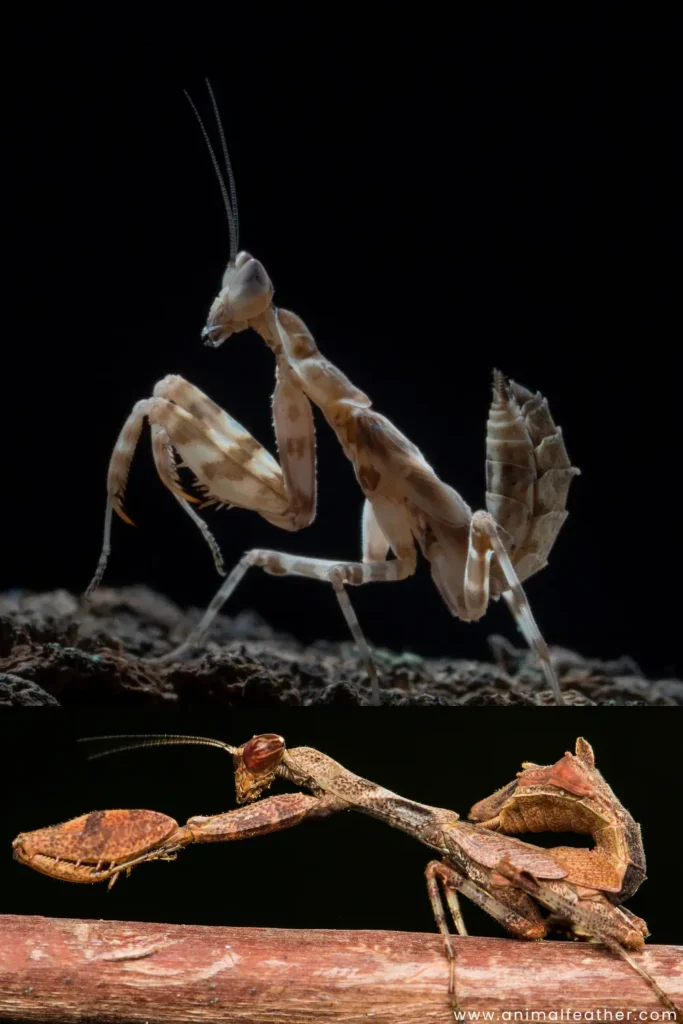

The ghost mantis (Phyllocrania paradoxa) is one of the most unusual praying mantis species in the insect world. Its body looks remarkably similar to a dry, curled leaf, allowing it to disappear among branches, shrubs, and dead vegetation. Unlike brightly colored mantises that resemble flowers, this species relies on a leaf-like appearance to avoid detection and catch unsuspecting insects.
Native to parts of Africa and Madagascar, the ghost mantis is a fascinating example of natural camouflage. Its unusual head crest, flattened body, and leaf-shaped legs make it especially popular among insect enthusiasts and exotic pet keepers.
Whether you want to learn about ghost mantis size, lifespan, diet, natural habitat, or captive care, this guide covers the essential information about this remarkable insect.
What Is a Ghost Mantis?
The ghost mantis (Phyllocrania paradoxa) is a species of praying mantis belonging to the order Mantodea. It is known for its impressive resemblance to a dead leaf, which helps it remain hidden in its natural surroundings.
Its scientific name refers to its unusual appearance and distinctive body structure. The name “ghost mantis” comes from its ability to blend into dry vegetation so effectively that it can be difficult to notice, even when it is sitting directly in front of you.
Unlike many other praying mantises, which have relatively smooth bodies, the ghost mantis has several leaf-like extensions and an irregular body outline. These features make it look like a piece of dried foliage rather than an insect.
Scientific Name and Classification
The scientific name of the ghost mantis is Phyllocrania paradoxa.
Its basic classification is:
| Classification | Details |
| Kingdom | Animalia |
| Phylum | Arthropoda |
| Class | Insecta |
| Order | Mantodea |
| Family | Hymenopodidae |
| Genus | Phyllocrania |
| Species | Phyllocrania paradoxa |
The ghost mantis is a true praying mantis, not a spider or a leaf insect. It belongs to a group of predatory insects that use specialized front legs to catch and hold their prey.
Why Is It Called a Ghost Mantis?
The name comes from its unusual leaf-like appearance and excellent camouflage.
Its flattened body, twisted head crest, and irregular leg extensions resemble dry leaves hanging from a branch. When it remains motionless among dead vegetation, its outline becomes difficult to distinguish from the surrounding plants.
This camouflage helps the ghost mantis avoid potential predators and capture insects that come within striking distance.
Where Do Ghost Mantises Live?
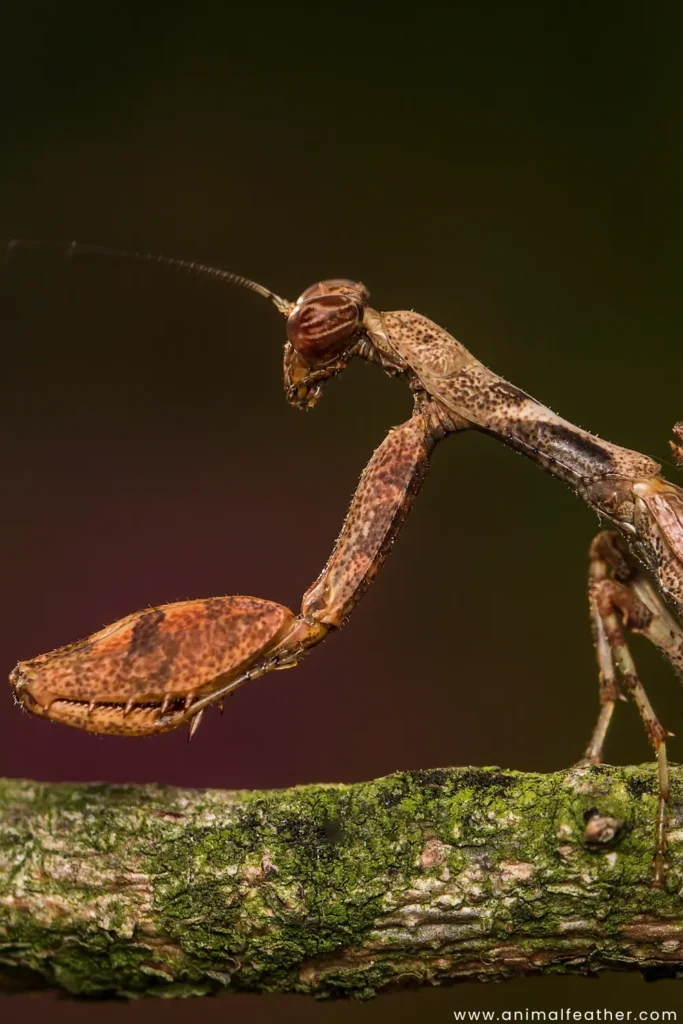
Ghost mantises are native to Africa and Madagascar. They are associated with warm environments where shrubs, bushes, and dry vegetation provide suitable places to hide and hunt.
They spend much of their time on branches and plants rather than walking around on the ground. Their natural body shape helps them blend into their surroundings while waiting for prey.
Natural Habitat
The natural habitat of a ghost mantis includes dry woodland, scrubland, shrubs, and areas with plenty of vegetation.
These environments provide several advantages:
- Branches and leaves offer places to rest and hide.
- Dry vegetation helps their body camouflage remain effective.
- Flying insects provide a regular source of food.
- Shrubs and small trees offer suitable positions for ambush hunting.
Ghost mantises are adapted to environments where they can remain still for long periods. Their appearance makes them especially difficult to notice when they resemble a curled or damaged leaf.
Countries Where Ghost Mantises Are Found
Ghost mantises are associated with several regions of sub-Saharan Africa and Madagascar.
Their documented range includes parts of eastern and southern Africa. Exact distribution can vary between populations, so it is better not to assume that the species occurs throughout every African country.
They are also bred in captivity by insect enthusiasts and specialist breeders in different parts of the world.
What Does a Ghost Mantis Look Like?
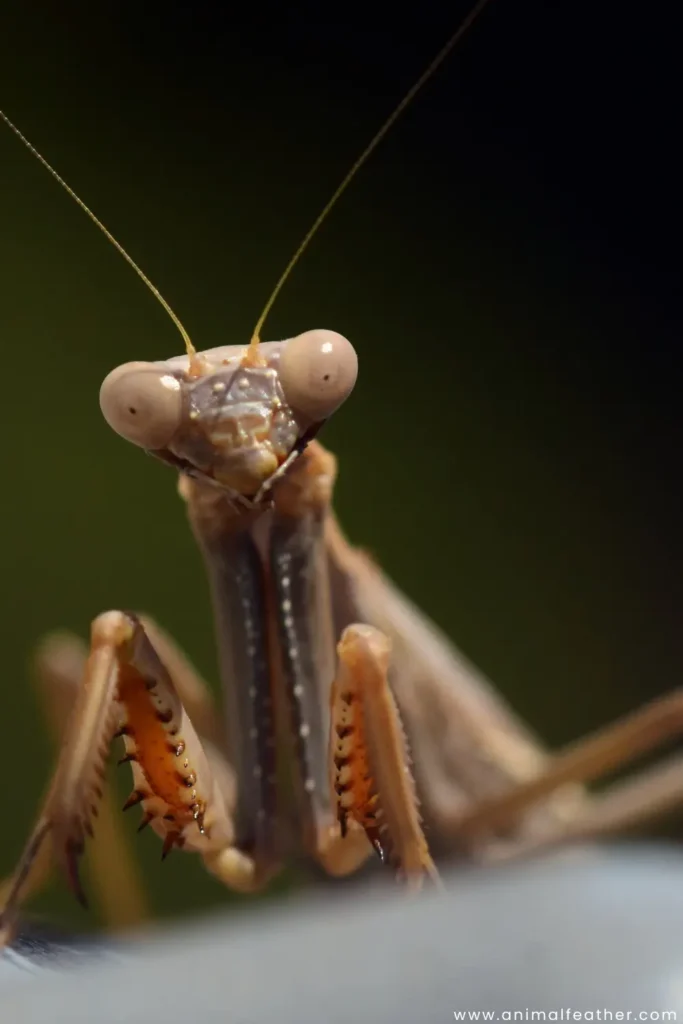
The ghost mantis has a distinctive appearance that makes it one of the most recognizable leaf-mimicking insects.
Its body is relatively small, with a flattened shape and several extensions that resemble dried leaves. A noticeable crest rises from the top of its head, giving it an unusual silhouette.
Most individuals display brown or tan coloration, although greenish and very dark individuals can also occur.
Color and Physical Features
Ghost mantises are commonly brown, tan, or beige, but their coloration can vary between individuals.
Some may appear greenish, while others have darker markings that help them blend into different types of vegetation.
Their most recognizable features include:
- Leaf-shaped body: The flattened body resembles a dry leaf.
- Head crest: A raised, irregular structure gives the head a distinctive appearance.
- Camouflaged legs: Extensions on the legs help break up the insect’s outline.
- Large eyes: Their eyes help them detect movement and locate prey.
- Raptorial front legs: These specialized legs are used to grab and hold insects.
The ghost mantis does not need to move constantly to hunt. Remaining still is an important part of its natural survival strategy.
Ghost Mantis Size
Adult ghost mantises generally grow to approximately 4–5 cm (1.6–2 inches) in body length.
Their exact size depends on individual development, sex, and environmental conditions. Females may become somewhat larger and broader than males, although the difference is not as dramatic as it is in some other mantis species.
| Growth Stage | Approximate Size |
| Newly hatched nymph | Small, only a few millimeters |
| Growing nymph | Increases in size after each molt |
| Adult male | Around 4–5 cm |
| Adult female | Around 4–5 cm, sometimes larger |
These measurements are approximate rather than fixed limits.
Male vs Female Ghost Mantis
Male and female ghost mantises can look similar, but there are some differences that help experienced keepers identify their sex.
Females usually have a broader abdomen, while males tend to have a slimmer body and longer antennae.
Abdominal segments can also help distinguish them after they have developed enough for the differences to become visible.
| Feature | Male Ghost Mantis | Female Ghost Mantis |
| Body shape | Usually slimmer | Usually broader |
| Abdomen | Narrower | Wider |
| Antennae | Generally longer | Generally shorter |
| Adult size | Around 4–5 cm | Around 4–5 cm, sometimes larger |
| Appearance | More slender | More robust |
These differences may be easier to recognize in mature individuals. Young nymphs can be difficult to identify accurately.
Ghost Mantis Lifespan
The ghost mantis has a relatively short life compared with many larger animals. Its lifespan depends on its sex, temperature, feeding conditions, and overall development.
A commonly reported estimate is approximately 6–12 months from hatching to the end of life. Individual mantises may live for shorter or longer periods depending on their conditions.
How Long Do Ghost Mantises Live?
Ghost mantises generally live for around six months to one year from hatching.
Their development includes several immature stages, during which they shed their outer exoskeleton and gradually become larger.
Temperature can influence their growth rate. Warmer conditions within a suitable range may speed up development, while cooler conditions can slow it down.
However, keeping a ghost mantis too warm or feeding it excessively is not a healthy way to extend or improve its life.
Male vs Female Lifespan
Male and female ghost mantises may have different adult lifespans.
Males often reach adulthood earlier, while females may take longer to complete their development. Adult lifespan can also vary with feeding frequency, temperature, and individual health.
There is no single lifespan that applies to every male or female ghost mantis.
Ghost Mantis Life Cycle
Like other praying mantises, ghost mantises undergo incomplete metamorphosis. They do not have a butterfly-like pupal stage.
Their life cycle includes the following stages:
- Egg Stage: A female lays eggs inside a protective foamy structure called an ootheca.
- Nymph Stage: Small ghost mantises hatch from the eggs and begin hunting tiny insects.
- Growth and Molting: The nymphs shed their outer exoskeleton several times as they grow.
- Adult Stage: After their final molt, they become sexually mature adults with fully developed wings.
Molting is essential for growth. During this process, the mantis needs a safe place to hang upside down so it can emerge from its old exoskeleton properly.
What Do Ghost Mantises Eat?
Ghost mantises are carnivorous insects that feed on other small animals, especially insects.
They are ambush predators rather than active hunters. Instead of chasing food over long distances, they usually remain motionless and wait for suitable prey to approach.
Flying insects are particularly useful food sources for this species.
Diet in the Wild
In their natural habitat, ghost mantises catch small insects that fly or move near branches and vegetation.
Their natural prey may include:
- Flies
- Moths
- Small flying insects
- Other suitable insects
Their leaf-like appearance helps them remain unnoticed while waiting for prey.
When an insect moves close enough, the mantis quickly extends its front legs and catches it.
What Do Ghost Mantises Eat in Captivity?
Ghost mantises kept as pets need a regular supply of suitable live feeder insects.
The size of the food should match the size of the mantis. Small nymphs need tiny insects, while larger individuals can eat bigger prey.
Common feeder insects include:
- Fruit flies: Suitable for young nymphs.
- Larger fruit flies: Useful as the mantis grows.
- Houseflies: Suitable for larger juveniles and adults.
- Blue bottle flies: A commonly used food source for adult ghost mantises.
- Small moths: Can provide another suitable flying prey option.
Flying prey is often preferred because ghost mantises naturally use ambush hunting strategies.
Avoid feeding insects that are too large or difficult for the mantis to catch. Wild-caught insects should also be avoided if their exposure to pesticides or parasites is unknown.
How Do Ghost Mantises Catch Their Prey?
Ghost mantises rely on camouflage and patience when hunting.
They often sit on branches or leaves and remain completely still. Their body shape makes them resemble dead vegetation, allowing insects to approach without immediately recognizing the danger.
When prey comes within reach, the mantis rapidly grabs it with its spiny front legs.
It then holds the insect securely while eating it with its mouthparts.
This hunting method helps the ghost mantis conserve energy while remaining effective at capturing suitable prey.
Ghost Mantis Care Guide
Ghost mantises are fascinating insects to keep, but they still need proper care and a suitable enclosure.
Their small size does not mean that they can live comfortably in any container. They require enough vertical space for molting, suitable ventilation, moderate humidity, and an appropriate supply of live food.
Ghost mantises are sometimes considered more manageable than certain other mantis species, but beginners should still learn their requirements before keeping one.
Ghost Mantis Enclosure Size and Setup
A ghost mantis needs a tall enclosure that allows it to climb and hang upside down during molting.
A commonly recommended adult enclosure size is approximately 20 × 20 × 30 cm, although a larger enclosure can provide more room.
A useful general rule is to provide an enclosure at least three times the mantis’s body length in height and around twice its body length in width.
A suitable enclosure should include:
- A secure, ventilated lid.
- A mesh or textured ceiling for gripping.
- Thin branches and twigs for climbing.
- Artificial or pesticide-free plants for hiding.
- Enough open space below its hanging position for molting.
- A secure design that prevents escape.
Young nymphs should be kept in smaller, escape-proof containers where they can easily find their food.
Avoid using an enclosure with a completely smooth ceiling. The mantis needs a surface that allows it to hold on securely while shedding its old skin.
Ghost Mantis Temperature Requirements
Ghost mantises generally do well in moderately warm conditions.
A practical daytime temperature range is approximately 22–26°C (72–79°F), with somewhat cooler conditions at night.
Use a digital thermometer to monitor the temperature inside the enclosure rather than relying only on the temperature of the room.
Avoid placing the enclosure in direct sunlight. A small container can heat up quickly and become dangerous for the mantis.
If additional heating is necessary, use a controlled and safe setup that does not create excessive heat.
Ghost Mantis Humidity Requirements
Humidity is an important part of ghost mantis care, particularly during growth and molting.
A relative humidity range of approximately 50–70% is a useful starting point for many setups. Some care guides recommend slightly higher humidity, depending on ventilation and environmental conditions.
Light misting can provide drinking droplets on the enclosure walls and plants.
However, the enclosure should not remain constantly wet. Excessive moisture combined with poor ventilation can encourage mold and bacterial growth.
A digital hygrometer can help monitor humidity levels.
Ghost Mantis Feeding Schedule
The amount and frequency of food depend on the mantis’s age, size, and appetite.
A general feeding approach is:
| Growth Stage | Suitable Food | General Frequency |
| Small nymphs | Tiny fruit flies | Every 1–2 days |
| Larger nymphs | Larger fruit flies | Every 1–2 days |
| Sub-adults | Suitable flies | Every 2–3 days |
| Adults | Houseflies or blue bottle flies | Every 2–3 days |
These are general guidelines, not a strict feeding timetable.
Watch the shape of the abdomen to help judge whether your mantis needs more food. A very thin abdomen may indicate hunger, while a rounded abdomen usually means it has recently eaten enough.
Remove uneaten prey when necessary, especially before a molt. Avoid leaving insects that could disturb or injure a vulnerable mantis.
Molting and Daily Care
Molting is one of the most important stages in a ghost mantis’s life.
As it grows, the mantis must shed its old outer covering to develop a larger body.
Before molting, it may stop eating, remain still, or spend more time hanging from a branch or the enclosure ceiling.
These changes are generally normal.
During this period:
- Do not handle or disturb the mantis.
- Remove live feeder insects from the enclosure.
- Maintain suitable humidity and ventilation.
- Make sure it has enough room to hang freely.
- Never pull the mantis away from its molting position.
After molting, its new outer covering remains soft for a period of time. Avoid handling it until the exoskeleton has hardened.
A failed molt can cause serious injury or even death, so providing enough vertical space and a suitable gripping surface is essential.
Can Ghost Mantises Live Together?
Ghost mantises are sometimes kept in communal groups because they may show lower cannibalism rates than many other mantis species.
However, this does not mean that keeping several individuals together is completely safe.
Cannibalism can still occur, particularly when individuals are different sizes, overcrowded, hungry, or disturbed during molting.
For beginners, keeping one ghost mantis per enclosure is the safer and simpler approach.
Are Ghost Mantises Good Pets?
Ghost mantises are popular among insect enthusiasts because of their unusual appearance and interesting hunting behavior.
They do not need the same amount of space as many larger pets, but their environmental and feeding requirements still need attention.
They are best suited to people who enjoy observing insects and are comfortable providing live feeder insects.
Are Ghost Mantises Suitable for Beginners?
Ghost mantises can be a reasonable choice for a beginner who has researched their care requirements.
They are relatively small and can live in a modest enclosure when it is properly designed.
However, new keepers must understand the importance of:
- Suitable temperature and humidity.
- Good ventilation.
- Proper enclosure height.
- Appropriate live food.
- Safe molting conditions.
Someone who cannot provide live feeder insects or monitor the enclosure should consider a different pet.
Can You Handle a Ghost Mantis?
Ghost mantises are delicate insects and do not need regular handling.
Although some individuals may walk onto a keeper’s hand, frequent handling can cause unnecessary stress or accidental injury.
It is better to observe them inside their enclosure.
If you need to move one, allow it to walk onto a branch or another suitable object rather than grabbing its body or legs.
Avoid handling a ghost mantis during molting or immediately afterward.
Do Ghost Mantises Bite?
Ghost mantises can bite if they feel threatened or mistake a finger for food.
However, they are not considered dangerous to humans and do not use venom to capture prey.
A bite may cause minor discomfort, so it is best to avoid unnecessary handling.
Can Ghost Mantises Fly?
Adult ghost mantises develop wings, but their flying ability is limited and can vary between individuals.
Males are generally more capable of flight than females, although neither sex should be expected to fly like a typical flying insect.
They usually spend much of their time climbing, hanging from branches, and waiting for prey.
Frequently Asked Questions About Ghost Mantises
Are Ghost Mantises Rare?
Ghost mantises are unusual insects in the wild, but they are also bred by specialist insect keepers.
Their availability in the pet trade depends on local breeders, seasonal availability, and regulations.
Are Ghost Mantises Aggressive?
Ghost mantises are generally ambush predators rather than aggressive animals.
They usually remain still and wait for prey. They may defend themselves if threatened, but they do not normally chase or attack humans.
What Is the Scientific Name of a Ghost Mantis?
The scientific name of the ghost mantis is Phyllocrania paradoxa.
It belongs to the order Mantodea and is recognized for its dead-leaf camouflage.
Do Ghost Mantises Change Color?
Ghost mantises can display different shades of brown, tan, green, and dark coloration.
Their appearance may vary between individuals and developmental stages. However, they should not be assumed to change color instantly like a chameleon.
How Many Times Does a Ghost Mantis Molt?
Ghost mantises molt several times as they grow from nymphs into adults.
The number of molts can vary with sex and development, but they need a safe hanging position for each successful molt.
How Much Does a Ghost Mantis Cost?
The price of a ghost mantis depends on its age, size, sex, breeder, and location.
Young nymphs and mature adults may have different prices. Shipping and enclosure equipment can also increase the total cost.
If you plan to buy one, choose a reputable breeder and check the rules for keeping or importing the species in your country.
Final Thoughts
The ghost mantis is a remarkable insect that demonstrates how effective camouflage can be in the natural world. Its dead-leaf appearance, unusual head crest, and patient hunting style make it one of the most interesting praying mantis species to observe.
Native to Africa and Madagascar, this small predator spends much of its time among branches and dry vegetation, waiting for insects to approach. Its diet, life cycle, and distinctive appearance make it a fascinating subject for insect enthusiasts.
Although ghost mantises can be kept in captivity, they need an appropriate enclosure, suitable temperature and humidity, live food, and enough space to molt safely.
Whether you are researching ghost mantis size, lifespan, diet, habitat, or care requirements, understanding its natural behavior is the best way to appreciate this unusual leaf-mimicking insect.