
Have you ever spotted a small red bird at your backyard feeder and wondered whether it was a House Finch or a Purple Finch? You’re not alone. These two North American songbirds look remarkably similar, especially when you’re trying to identify them from a distance.
The good news is that a few details can help you tell them apart. Their colour patterns, facial markings, body shape, and bills offer useful clues. Female birds can be more challenging to identify because both species are mostly brown and streaked.
In this guide, we’ll compare House Finches and Purple Finches, explain the differences between males and females, and share practical tips to help you identify them in the wild or at a bird feeder.
House Finch vs Purple Finch: Quick Comparison
| Feature | House Finch | Purple Finch |
| Scientific name | Haemorhous mexicanus | Haemorhous purpureus |
| Male colour | Usually rosy red, orange, or sometimes yellowish | Raspberry-red or pinkish-red |
| Female colour | Brownish with blurry streaks | Brown with stronger facial markings and clearer streaks |
| Body shape | Relatively slender | Often appears stockier |
| Bill | Thick and curved | Strong, conical bill |
| Female face | Usually plain, without a strong eyebrow pattern | Often has a noticeable pale eyebrow and darker facial markings |
| Common habitat | Cities, suburbs, farms, open woodland, and backyards | Coniferous and mixed forests; also visits backyards in winter |
| Distribution | Western North America and much of the eastern United States | Parts of Canada and the United States, with eastern and Pacific populations |
| Feeder food | Sunflower seeds and other plant foods | Especially fond of black-oil sunflower seeds |
Although these features are useful, no single characteristic is perfect for every bird. Age, lighting, individual variation, and geographic location can affect appearance.
Male House Finch vs Male Purple Finch
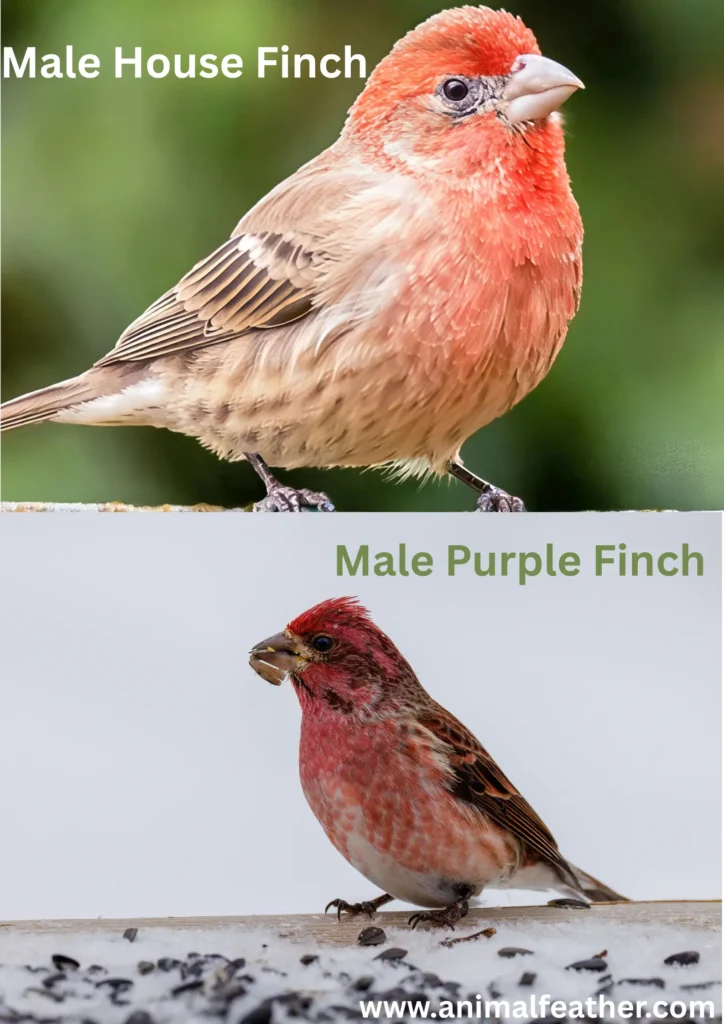
Male House Finches and male Purple Finches are easier to distinguish than females because their plumage has different patterns and shades of red.
Male House Finch
A male House Finch usually has rosy red or reddish-orange colouring around its face, forehead, throat, and upper breast. Its back, belly, and sides are generally brown with noticeable streaking.
One interesting detail is that not every male House Finch is bright red. Some appear orange, yellowish, or pale reddish. The intensity of their colour is influenced by pigments in their diet.
House Finches have a fairly sturdy, curved beak. Their sides and belly often show distinct brown streaks.
Male Purple Finch
A male Purple Finch usually has a raspberry-red or pinkish-red appearance across its head, breast, and back. Rather than having red limited mainly to the face and upper breast, its colour often spreads more broadly over the body.
Its underside may look lighter, with a cloudy white appearance. Compared with a typical male House Finch, a Purple Finch often looks softer and more evenly coloured.
The Purple Finch also tends to have a fuller, stockier appearance. However, body shape can be difficult to judge when a bird is sitting at an unusual angle.
Main Differences Between the Males
When comparing the two males, look at these details:
- Colour distribution: House Finch red is often concentrated around the face and upper breast, while Purple Finch red commonly extends across more of the head, breast, and back.
- Colour shade: House Finches can range from yellowish-orange to red. Purple Finches are often recognised by their distinctive raspberry-red or pinkish-red colouring.
- Body markings: House Finches usually show noticeable streaking on the belly and flanks.
- Overall appearance: Purple Finches often look fuller and more uniformly coloured.
Don’t identify a bird by colour alone. Look at its bill, streaking, body shape, and location too.
Female House Finch vs Female Purple Finch
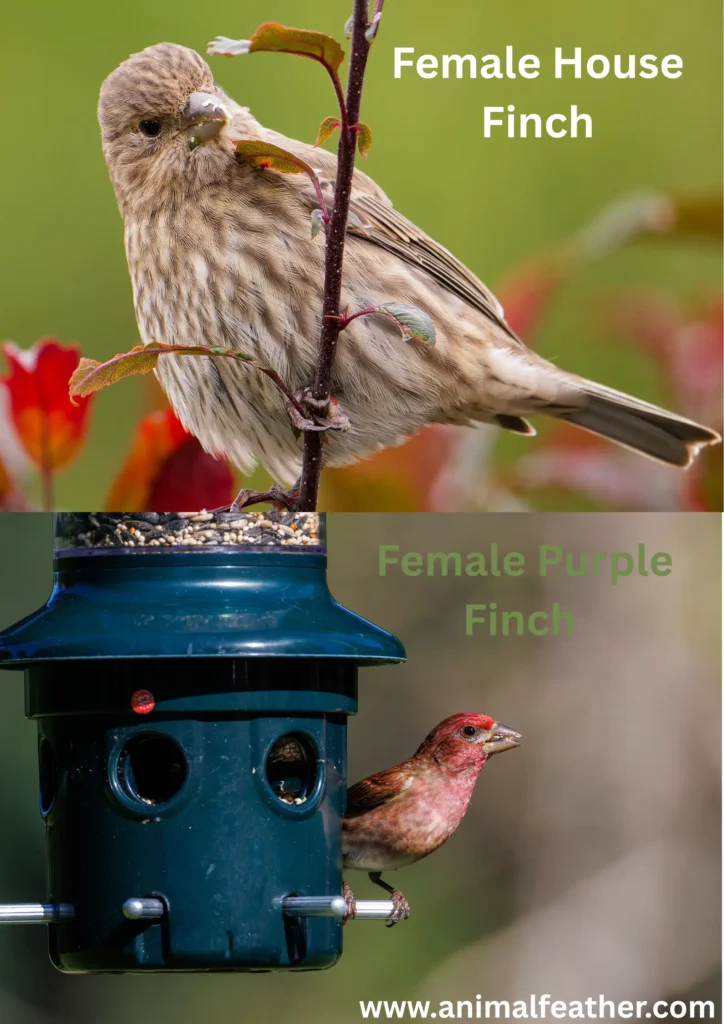
Female House Finches and Purple Finches can be especially confusing. Neither has the bright red plumage commonly associated with adult males. Both are mainly brown, with streaked underparts.
The most helpful difference is often their facial pattern.
Female House Finch
A female House Finch is generally grayish-brown or brown, with thick, somewhat blurry streaks across the breast, belly, and sides.
Its face is usually fairly plain. It doesn’t normally show the strong pale eyebrow and dark facial markings that make a female Purple Finch distinctive.
Look for a simple facial pattern and broad, blurry streaking when identifying a possible female House Finch.
Female Purple Finch
A female Purple Finch is also brown and streaked, but its face often has a more noticeable pattern.
Look for:
- A pale or whitish eyebrow above the eye.
- A darker line along the side of the throat.
- More clearly defined streaks across the breast and flanks.
- A somewhat fuller head and body shape.
These markings can make a female Purple Finch look more strongly patterned than a female House Finch.
How to Tell the Females Apart
If you see a brown finch at a feeder, start by examining its face.
A female Purple Finch often has a distinct pale eyebrow and darker facial markings. A female House Finch usually has a plainer face and blurrier streaking.
However, western Purple Finches can have less distinct facial patterns than eastern birds. This is why it’s useful to examine several features instead of relying on one marking.
Other Differences Between House Finches and Purple Finches
Colour and facial patterns are important, but there are other clues worth observing.
Size and Body Shape
Both species are small songbirds and are similar in overall size. House Finches typically measure around 5.1–5.5 inches long, while Purple Finches measure approximately 4.7–6.3 inches.
These ranges overlap, so size alone isn’t a reliable way to identify one.
A House Finch often looks somewhat slender, with a relatively long-looking tail. A Purple Finch can appear chunkier, with a fuller head and body.
Bill Shape
Both birds have strong, cone-shaped bills adapted for eating seeds.
A House Finch’s bill often looks thick, with a noticeably curved profile. A Purple Finch also has a powerful conical bill, which can appear larger and more robust.
Because their bills are similar, use this feature alongside colour patterns and facial markings.
Songs and Calls
Both species produce songs and calls, but their sounds can help experienced birdwatchers distinguish them.
House Finches are known for their lively, warbling songs. Purple Finches also produce rich, warbling songs, often heard from trees in their forest habitats.
Listening carefully can help, especially when the birds are difficult to see. However, songs can vary between individuals and regions, so sound should be used as another clue rather than the only identification method.
Where Do House Finches and Purple Finches Live?
Their geographic ranges overlap in some parts of North America, but their preferred habitats are not exactly the same.
House Finch Range and Habitat
House Finches originally lived in western North America and Mexico. They are now widespread across much of the United States and parts of southern Canada.
Their eastern population developed after captive birds were released on Long Island, New York, in the 1940s. The species subsequently spread across much of the eastern United States.
House Finches are highly adaptable. You may find them in:
- Residential gardens and backyards.
- City parks and urban neighbourhoods.
- Farms and agricultural areas.
- Open woodland and forest edges.
- Desert and grassland habitats in parts of their native western range.
They are particularly familiar visitors to backyard bird feeders.
Purple Finch Range and Habitat
Purple Finches can be found across certain regions of the United States and Canada. Their breeding populations include eastern North America and the Pacific Coast.
They are more closely associated with forests than House Finches, particularly coniferous and mixed woodlands. During winter, they may also visit forest edges, shrublands, open fields, and residential backyards.
Purple Finches can move considerable distances in response to food availability. Their winter distribution may vary from year to year, partly because they follow changing supplies of tree seeds.
House Finch vs Purple Finch Migration
House Finches are generally resident birds across much of their range. Many remain in the same general area throughout the year, although local movements can occur.
Purple Finches are more irregular migrants. Some populations move south during winter, and their movements can change depending on the availability of seeds, particularly from conifer trees.
This means that the time of year and your location can provide useful clues when identifying a visiting finch.
What Foods Do House Finches and Purple Finches Prefer?
Both species mainly eat plant foods, especially seeds, buds, and fruits. Backyard bird feeders are another place where these birds frequently gather.
House Finch Diet
House Finches eat a wide variety of seeds and plant materials. Their natural foods include seeds from weeds and other plants, as well as fruits and buds.
At bird feeders, they commonly eat:
- Black-oil sunflower seeds.
- Millet.
- Other small seeds.
- Fruits and berries when available.
They often gather in groups and can become regular visitors when a reliable food source is available.
Purple Finch Diet
Seeds, plant buds, and various fruits make up part of the Purple Finch’s diet. They often forage in trees, where they feed on seeds and soft buds from different plants.
At feeders, they readily eat black-oil sunflower seeds. In natural habitats, their diet changes with the season and the food available.
Do They Visit the Same Bird Feeders?
Yes. House Finches and Purple Finches may visit the same backyard feeders, particularly where sunflower seeds are offered.
If you want to attract finches, try a clean feeder filled with black-oil sunflower seeds. Place it somewhere birds can reach safely, with nearby trees or shrubs that provide cover.
Keep feeders clean and remove spoiled or wet food. Good feeder hygiene helps reduce the spread of disease among visiting birds.
Birds That Look Like House Finches
House Finches and Purple Finches aren’t the only birds that can cause identification confusion. Several other species have similar colours or body shapes.
Cassin’s Finch
Cassin’s Finch is one of the closest lookalikes. Adult males have red or raspberry-coloured plumage, while females are brown and streaked.
Cassin’s Finches are primarily found in forested mountain regions throughout western North America. Their range and habitat can help separate them from House and Purple Finches.
Pine Siskin
Pine Siskins are small, streaky finches with pointed bills and yellow markings in their wings and tails. They may visit the same feeders as House and Purple Finches.
Their overall appearance is less red, and their yellow wing markings provide a useful identification clue.
House Sparrow
House Sparrows can also be confused with finches, especially when viewed quickly. However, adult male House Sparrows have a black bib and a different head pattern, while females are generally brown with a pale eyebrow.
Looking at the bird’s bill, face, and overall markings can help you avoid confusing these species.
How to Identify a House Finch or Purple Finch at Your Feeder
When a finch visits your backyard, take a few seconds to observe it before deciding which species it is.
Use this simple checklist:
- Look at the colour: Is the male reddish-orange, yellowish, or raspberry-red?
- Check the face: Does a brown bird have a noticeable pale eyebrow and darker facial markings?
- Observe the streaks: Are the breast and flank streaks blurry or more clearly defined?
- Examine the bill: Does it look thick and curved, or more robust and conical?
- Consider the location: Is the bird in a city neighbourhood, open woodland, or a northern coniferous forest?
- Listen to its song: If you can hear it clearly, the song may provide another identification clue.
If you’re still unsure, take a photograph. Comparing the bird’s facial pattern, bill, and body markings with reliable field-guide images can make identification easier.
Frequently Asked Questions
Are House Finches and Purple Finches Different Species?
No. House Finches (Haemorhous mexicanus) and Purple Finches (Haemorhous purpureus) are two different species. They belong to the same genus and family, which helps explain why they share several physical features.
Which Bird Has a Deeper Red Colour: The House Finch or the Purple Finch?
Male Purple Finches often have a raspberry-red or pinkish-red appearance across much of the head and body. Male House Finches can range from yellowish-orange to bright red, depending partly on their diet.
The shade alone isn’t enough to identify either bird.
Are Female House Finches and Purple Finches Difficult to Tell Apart?
Yes. Both females are brown and streaked. A female Purple Finch often has a more noticeable pale eyebrow and darker facial markings, while a female House Finch usually has a plainer face and blurrier streaking.
Do the Habitats of House Finches and Purple Finches Overlap?
Their ranges overlap in parts of North America. Both species may visit backyard feeders, although House Finches are more commonly associated with residential and urban habitats, while Purple Finches are strongly associated with forests.
Which Finch Visits Bird Feeders More Often?
House Finches regularly visit garden feeders and are commonly seen in backyards throughout many parts of their habitat. Purple Finches also visit feeders, particularly during winter in areas where they occur.
Black-oil sunflower seeds can attract both species.
Final Thoughts
House Finches and Purple Finches may look almost identical at first, but their colour patterns, facial markings, and body shapes offer useful clues.
Male House Finches often have red concentrated around the face and upper breast, while male Purple Finches commonly show a broader raspberry-red appearance. Female Purple Finches usually display more noticeable patterns on their faces compared with female House Finches.
The best way to identify either bird is to consider several features together, including its plumage, bill, shape, habitat, and location. With a little practice, you’ll become more confident at telling these two beautiful finches apart.