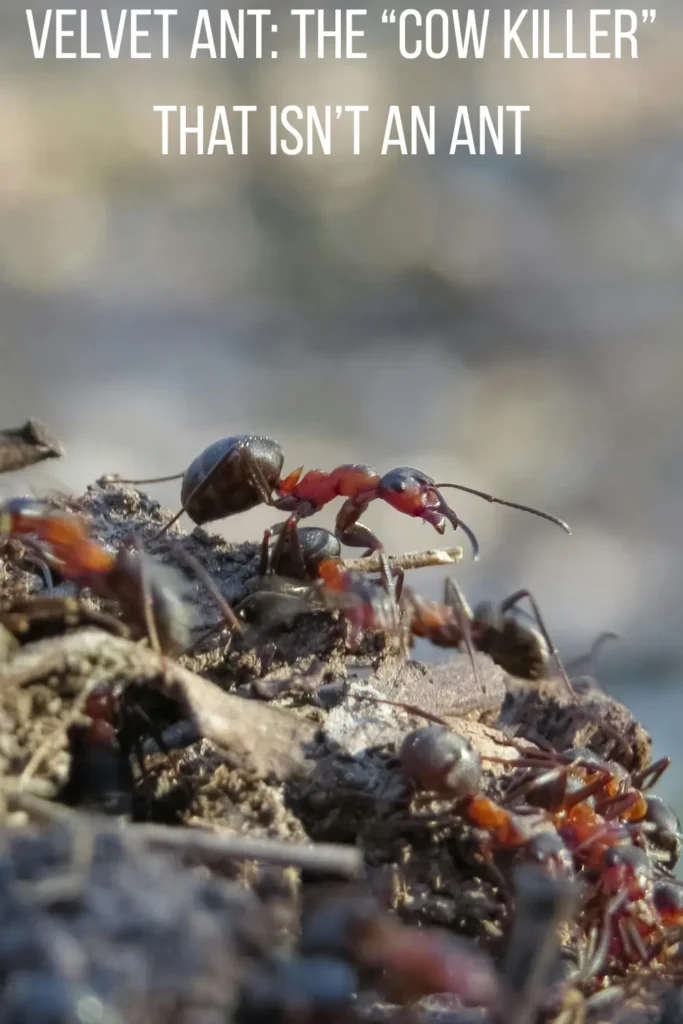

Imagine walking through a sunny field when you notice a bright red, fuzzy insect crawling across the ground. At first glance, it looks harmless—almost cute. But this tiny creature has earned one of the most intimidating nicknames in the insect world: the cow killer.
Despite its name, the velvet ant isn’t actually an ant. It’s a type of wingless female wasp known for its colorful appearance and incredibly painful sting. While it won’t kill cows or humans, it’s certainly an insect you’ll want to admire from a safe distance.
In this guide, you’ll discover everything about velvet ants, including where they live, what they eat, why they sting, whether they’re dangerous, and many fascinating facts you probably didn’t know.
Table of Contents
What Is a Velvet Ant?
The velvet ant belongs to the family Mutillidae, a group containing more than 7,000 species worldwide. Female velvet ants have no wings, making them look like large ants, while males have wings and resemble typical wasps.
Their bodies are covered in dense, colorful hairs that create a soft velvet-like appearance—hence the name velvet ant.
Although they look fuzzy and harmless, they’re equipped with powerful defenses that help them survive in the wild.
Quick Facts About Velvet Ant
| Feature | Details |
|---|---|
| Scientific Family | Mutillidae |
| Type | Wasp (Not an ant) |
| Nickname | Cow Killer Ant |
| Size | 0.2–1 inch (5–25 mm) |
| Color | Red, orange, black, white, yellow |
| Lifespan | Around 1 year |
| Sting | Extremely painful |
| Wings | Females wingless, males winged |
| Habitat | Dry, sandy areas worldwide |
Why Is It Called the Cow Killer?
The nickname “cow killer ant” often scares people.
Thankfully, it’s mostly a myth.
The name comes from the insect’s exceptionally painful sting, not because it kills livestock.
A velvet ant sting is among the most painful insect stings in North America. The pain can be intense for several minutes, but it rarely causes serious medical problems unless someone has an allergic reaction.
So, despite the dramatic nickname, velvet ants do not kill cows.
Is a Velvet Ant Actually an Ant?
No.
One of the biggest misconceptions is that velvet ants belong to the ant family.
In reality, they’re parasitic wasps.
Here’s how scientists tell the difference:
- Females don’t have wings.
- Their bodies are covered with thick hairs.
- They have a narrow wasp-like waist.
- They develop by parasitizing other insects.
- Males have wings and look like wasps.
The wingless females are what most people mistake for ants.
Where Do Velvet Ants Live?
Velvet ants are found on almost every continent except Antarctica.
They prefer:
- Sandy soils
- Dry grasslands
- Meadows
- Forest edges
- Deserts
- Gardens
- Hiking trails
They’re especially common during warm summer months when females wander the ground searching for host nests.
Velvet Ant Habitat
These insects spend most of their lives close to the ground.
You’ll often spot them:
- Crawling on dirt paths
- Around dead logs
- Under rocks
- Near bee nests
- Around ground-nesting wasps
Unlike social ants, velvet ants live alone.
What Do Velvet Ants Eat?
Adult velvet ants mainly feed on:
- Flower nectar
- Plant juices
- Sweet liquids
- Honeydew from aphids
Their larvae have a very different diet.
Young velvet ants feed on:
- Bee larvae
- Wasp larvae
- Pupae
- Stored food inside host nests
Life Cycle of a Velvet Ant
Velvet ants have one of the most unusual life cycles among insects.
Step 1: Finding a Host
The female searches for underground nests belonging to solitary bees or wasps.
Step 2: Laying Eggs
She sneaks inside and lays an egg beside the host larva.
Step 3: Larval Stage
Once the egg hatches, the velvet ant larva consumes the host larva and its stored food.
Step 4: Pupa
The larva forms a cocoon and transforms into an adult.
Step 5: Adult
Adults emerge during warm weather to mate and continue the cycle.
Why Is Their Sting So Painful?
Female velvet ants have one of the longest stingers relative to body size among insects.
Scientists believe the sting evolved as protection against predators.
Their sting ranks very high on pain scales because it delivers venom deep into the skin.
The pain is often described as:
- Sharp
- Burning
- Electric
- Intense
- Sudden
Fortunately, it usually fades within an hour.
Do Velvet Ants Bite?
Not really.
Their jaws are too small to cause significant injury.
Instead, females defend themselves with their powerful sting.
Only females can sting because the stinger is a modified egg-laying organ.
Males cannot sting.
Are Velvet Ants Dangerous?
For most healthy people, velvet ants are not life-threatening.
You may experience:
- Immediate pain
- Swelling
- Redness
- Mild itching
Seek medical attention if you experience:
- Difficulty breathing
- Swelling of the throat
- Dizziness
- Severe allergic reaction
Natural Predators
Even with their painful sting, some animals still hunt velvet ants.
Predators include:
- Lizards
- Birds
- Praying mantises
- Large spiders
- Toads
Their bright colors warn predators to stay away.
Amazing Defenses of Velvet Ants
Velvet ants rely on several layers of defense.
Bright Warning Colors
Their red and orange bodies advertise danger.
Thick Exoskeleton
Their armor is surprisingly hard.
Many predators struggle to crush them.
Loud Squeaking
Velvet ants produce squeaking sounds by rubbing body parts together.
This unusual defense can surprise predators.
Painful Sting
Their last line of defense is the famous sting.
Interesting Velvet Ant Facts
Here are some fascinating facts:
- There are over 7,000 species worldwide.
- Females have no wings.
- Males can fly.
- They’re actually wasps.
- They parasitize bee and wasp nests.
- Their colorful bodies warn predators.
- Their exoskeleton is extremely tough.
- They can produce squeaking sounds.
- Only females sting.
- They rarely attack unless handled.
Velvet Ant vs Fire Ant
| Feature | Velvet Ant | Fire Ant |
|---|---|---|
| Actually an Ant? | No | Yes |
| Lives in Colonies? | No | Yes |
| Sting Pain | Extremely painful | Painful |
| Wings | Only males | Reproductive ants only |
| Lifestyle | Solitary | Social |
| Diet | Nectar & insect larvae | Omnivorous |
Velvet Ant vs Wasp
Although velvet ants are wasps, they look very different.
| Velvet Ant | Typical Wasp |
|---|---|
| Hairy body | Smooth body |
| Female wingless | Females winged |
| Walks on ground | Flies frequently |
| Solitary | Often social |
| Bright warning colors | Usually yellow and black |
Can Velvet Ants Be Pets?
Keeping velvet ants as pets is generally not recommended.
Reasons include:
- Extremely painful sting
- Difficult care requirements
- Solitary behavior
- Specialized life cycle
- Limited availability of suitable food
They’re best appreciated in their natural habitat.
How to Avoid Being Stung
If you encounter a velvet ant:
- Never pick it up.
- Watch where you step.
- Wear shoes outdoors.
- Leave it alone.
- Teach children not to touch brightly colored insects.
Remember, velvet ants don’t chase people.
They sting only when threatened.
Ecological Importance
Despite their fearsome reputation, velvet ants play an important role in nature.
They help:
- Regulate populations of solitary bees and wasps
- Support ecological balance
- Contribute to food webs
- Increase biodiversity
Every species has its place in healthy ecosystems.
Frequently Asked Questions (FAQs)
Can a velvet ant kill a human?
No. Their sting is extremely painful but is not deadly for most people. Severe allergic reactions are rare but require immediate medical care.
Why is it called a cow killer?
The nickname refers to the intensity of the sting, not because it kills cows.
Are velvet ants aggressive?
No. They usually avoid people and sting only when touched or trapped.
Can male velvet ants sting?
No. Only females have stingers.
Are velvet ants beneficial?
Yes. They help maintain ecological balance by parasitizing certain solitary bees and wasps.
Where are velvet ants most common?
They’re common in warm, dry regions with sandy soil, including parts of North America, South America, Africa, Europe, Asia, and Australia.
Final Thoughts
The velvet ant is one of nature’s best examples of why appearances can be deceiving. Its fuzzy, colorful body might look harmless, but beneath that velvet coat is a highly adapted wasp with remarkable defenses and a famously painful sting.
While its nickname, “cow killer,” sounds alarming, there’s no need to fear these insects if you simply give them space. They are solitary, play an important role in ecosystems, and would rather avoid conflict than sting.
The next time you spot a bright red “ant” wandering across a trail, you’ll know you’re looking at one of the insect world’s most fascinating impostors—not an ant at all, but a resilient wasp with an incredible survival strategy.